What Do You Need to Report Under RIDDOR?
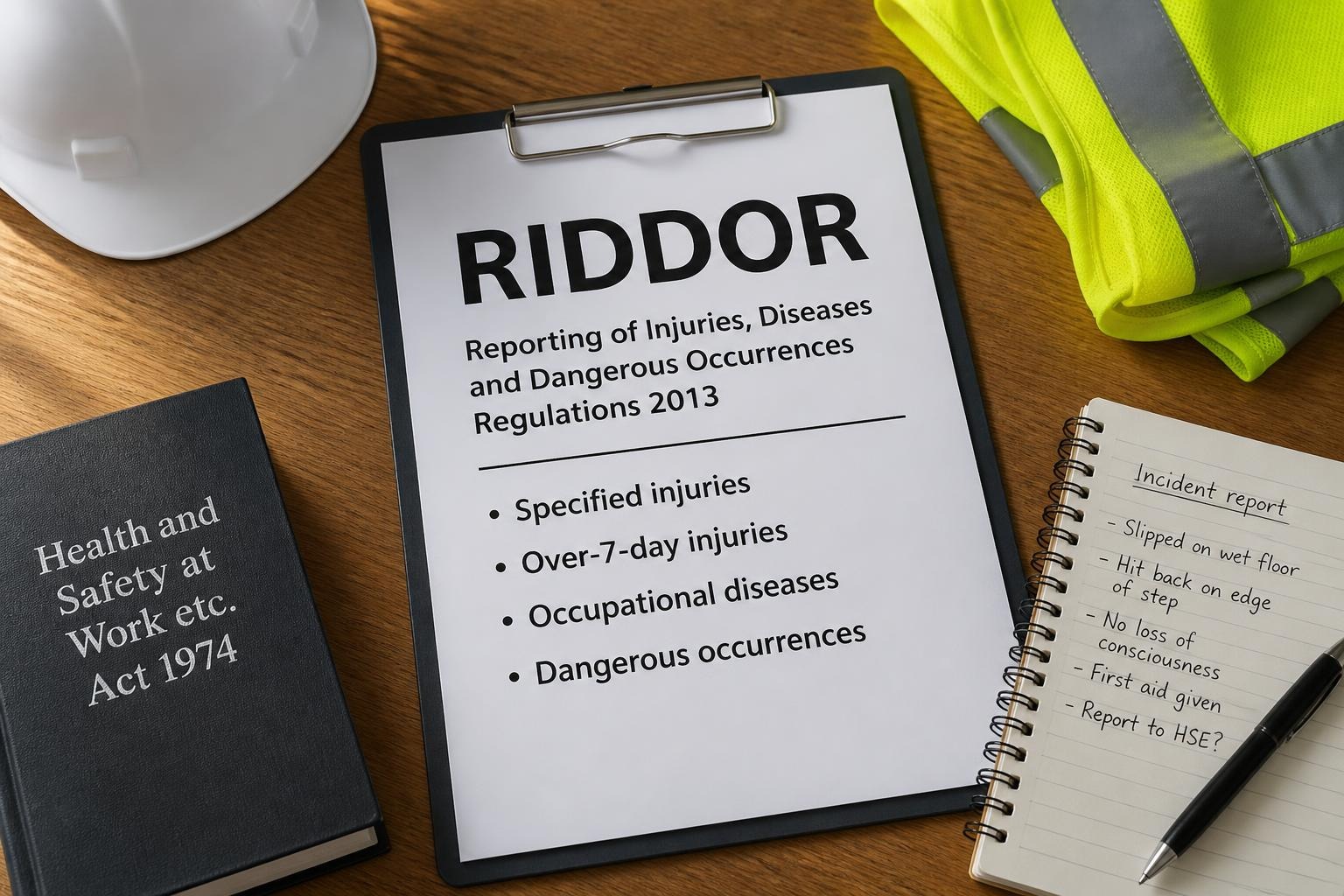
Under RIDDOR you must report work related deaths, specified injuries, injuries that keep a worker off their normal duties for more than seven consecutive days, injuries to members of the public who are taken to hospital, certain occupational diseases and certain dangerous occurrences.
That three day and seven day distinction is where most employers go wrong, so it is worth being precise about it.
This guide covers RIDDOR 2013, which applies in Great Britain. Northern Ireland has its own equivalent regulations, enforced by HSENI.
HSE consulted on reforms to RIDDOR in 2026, covering the lists of reportable diseases and dangerous occurrences, who can diagnose an occupational disease, clearer definitions and a simpler reporting form. The consultation closed in June 2026 and HSE has not yet published its response. Until any changes become law, the current regulations described here still apply.
What must be reported
Deaths
Any work related death must be reported. This includes deaths of workers and of non workers, such as members of the public, where the death arose from a work activity.
If a worker dies within one year of a reportable injury as a result of that injury, the employer must also notify the enforcing authority, even if the original injury has already been reported.
Specified injuries to workers
A defined list of serious injuries, including fractures other than to fingers, thumbs and toes, amputations, injuries likely to lead to permanent loss or reduction of sight, crush injuries to the head or torso causing damage to the brain or internal organs, serious burns, scalpings requiring hospital treatment, loss of consciousness from head injury or asphyxia and injuries from working in an enclosed space leading to hypothermia, heat induced illness or resuscitation or admittance to hospital for more than 24 hours.
Injuries to people not at work
Where a member of the public or anyone else not at work is injured by a work activity and taken directly from the scene to hospital for treatment, the injury is reportable. Going to hospital purely as a precaution, or only for examination or diagnostic tests, does not count as treatment.
Over seven day injuries
Where a worker is away from work or unable to do their normal duties for more than seven consecutive days as a result of a work related injury. The day of the accident is not counted, but weekends and rest days are.
Occupational diseases
Where a doctor gives a written diagnosis of a listed work related disease, such as carpal tunnel syndrome, occupational dermatitis, hand arm vibration syndrome, occupational asthma, tendonitis of the hand or forearm, or occupational cancer linked to a known exposure.
Dangerous occurrences
Near misses of a defined type, listed in the regulations. Examples include the collapse or overturning of lifting equipment, the accidental release of a substance that could cause injury, plant coming into contact with overhead power lines and structural collapse.
The deadlines
- Deaths: notify the enforcing authority without delay, and a report must be received within 10 days
- Specified injuries: notify without delay, report within 10 days
- Injuries to people not at work taken to hospital: notify without delay, report within 10 days
- Dangerous occurrences: notify without delay, report within 10 days
- Over seven day injuries: report within 15 days of the incident
- Occupational diseases: report as soon as the responsible person receives the written diagnosis
Reports go to HSE through the online forms. For fatal and specified injury incidents there is also a telephone line.
What you record rather than report
Accidents that result in a worker being away from work or unable to do their normal duties for more than three consecutive days must be recorded, but not reported. For most employers, an entry in the accident book under social security law is enough.
So the sequence runs: over three days, record it. Over seven days, record it and report it.
Who has to report
The duty sits with the "responsible person". For an employee injury that is the employer. For a self employed person injured on someone else's premises it is normally the person in control of those premises. For dangerous occurrences it is usually whoever is in control of the premises or the work.
On multi contractor sites this is worth agreeing in advance, because assuming someone else has reported it is a common failure.
What records you must keep
You must keep records of reportable injuries, over seven day injuries, work related diseases and dangerous occurrences. If you do not keep a copy of the online form, your record must include the date and method of reporting, the date, time and place of the event, personal details of those involved and a brief description of what happened.
An accident book can cover injuries, but you will need a separate method for cases of disease.
Records must be kept for at least three years from the date they are made.
Why this matters beyond compliance
Two practical points.
First, the seven day clock runs quietly. An injury that looked minor on the day becomes reportable a week later when the worker is still on light duties and by then nobody is thinking about it. Missing the deadline is one of the most common RIDDOR failures.
Second, HSE does not pass your reports to your insurer. If you need them to know, you have to tell them separately.
How TalkHSE helps
TalkHSE lets workers report incidents, near misses and hazards from site on their phone, so events get captured when they happen rather than reconstructed later. Each report can be tracked through investigation to the actions that come out of it and the days lost can be followed so a seven day threshold does not pass unnoticed.
Because incidents, actions and toolbox talks sit in the same system, what you learn from an event can be turned into a briefing for the people who need it.
Frequently asked questions
Do I have to report every accident at work?
No. Only the categories set out in RIDDOR. Most minor injuries are recorded in the accident book rather than reported.
Do weekends count towards the seven days?
Yes. The count is of consecutive days, not working days and it excludes the day of the accident itself.
Is a near miss reportable under RIDDOR?
Only if it is one of the listed dangerous occurrences. Other near misses should still be recorded and investigated, because they are the cheapest warning you will get.
What happens if you fail to report under RIDDOR?
It is a criminal offence. In practice it also damages your position in any investigation or claim, because it looks like the event was not taken seriously.
Does RIDDOR apply to members of the public?
Yes. Work related accidents to people who are not at work are reportable where the person is taken from the scene to hospital for treatment of that injury.
More Articles